Tabella dei contenuti
Words can do everything: they can be walls or windows, they can hurt or heal, they can change people, and the world.
It’s the year 2018. Facebook, the social media platform par excellence, is going through a terrible year due to the “Cambridge Analytica” scandal. Harry and Meghan celebrate their Royal Wedding despite royal differences and expectations. Twelve Thai children remain trapped in a cave, fortunately, they are rescued. Trump and Kim move from nuclear threats to a handshake of peace. Silvia Romano is kidnapped in Kenya. In Europe, the first populist government is formed and Brexit negotiations continue. Aretha Franklin, the Queen of Soul, passes away.
It’s a strange year. While I try not to be overwhelmed by the negative news coming from the world, an idea begins to sprout in me: creating a book about words that do good. Why?
Simple. I am someone who speaks little; I prefer to observe, listen, and write. At a certain point in 2018, I stop to observe what is happening around me: people, their actions, their deeds, my own. I realize that listening is one of the hardest practices to master, even more so in a society that never stops. I reflect on how far humanity has come from its beginnings up to 2018.
Along the long path of our evolution, we have made many discoveries: some essential, like fire; some useful, like the wheel and penicillin; others far less helpful, if not truly terrible, like the atomic bomb.
In our pursuit of satisfying our needs, seeking happiness, and achieving hypothetical perfection, we have taken giant leaps and never stopped: industries, science and technology, large houses, skyscrapers, we have created every kind of comfort.
We’ve become so accustomed to moving fast that stopping seems almost impossible. Isn’t that true?
These are the questions that still resonate within me and that I try to answer. I decide to stop, to listen to myself.
We have started pointless wars, created borders that exist only in our minds, and lost the habit of communicating with neighbors, of truly knowing one another. We have lost the use of words, that skill we acquired long ago, alongside fire and the sense of being together.
I wonder if we can recover it. I realize that my journey is a search for forgotten words and gestures, a desire to fulfill a need — perhaps not only my own. I take pen and paper and reflect on words that are missing, both in our professional and personal lives. I begin a journey to rediscover time and attention toward others, words we need to hear, words that support overlooked gestures, words that were taught to me as a child but have also been lost within me.
I select some that I consider essential and decide to involve the artist and friend Nicola Grotto in the project. I appreciate technology and have a professional background mainly in communication and digital media. I also love paper, and my desire is to create a physical project that unites words and images.
Nicola lives and works in Pramaggiore, in the province of Venice. After completing high school in Portogruaro and studying Visual and Performing Arts in Venice, he decided to dedicate himself to his lifelong passion: drawing. Self-taught and a lover of street art, he embarked on a path that over the years led him to express himself artistically through portraiture. Nicola is the perfect artist to collaborate with, to create the illustrations that accompany the words and reflections of the book. I am delighted by his enthusiasm; his works represent the style of images I want to include.
While Nicola works on the illustrations, I ask myself: why stop at Italian? After all, these are words known to humanity as a whole. I start sharing the project with friends around the world and request translations. It is an opportunity to discover classical languages like Greek; modern ones like English and French; ancient ones like Chinese and Arabic; important ones like Swahili; almost forgotten ones like Changana. I rely on the girls from the agency Le Maus in Reggio Emilia for book design and on a crowdfunding campaign to cover production costs. The support is immense! It’s wonderful to see people still believing in the magical power of words. I search for community builders, and thus, the words of humanity are born.
Hope, love, hello, welcome! And then: thank you, help me, peace, try. Unique, beauty, forgive me, smile, light. Not forgetting kindness, education, respect, courage, humility, dignity, empathy. Listen to me, live fully, future, let’s stay human.
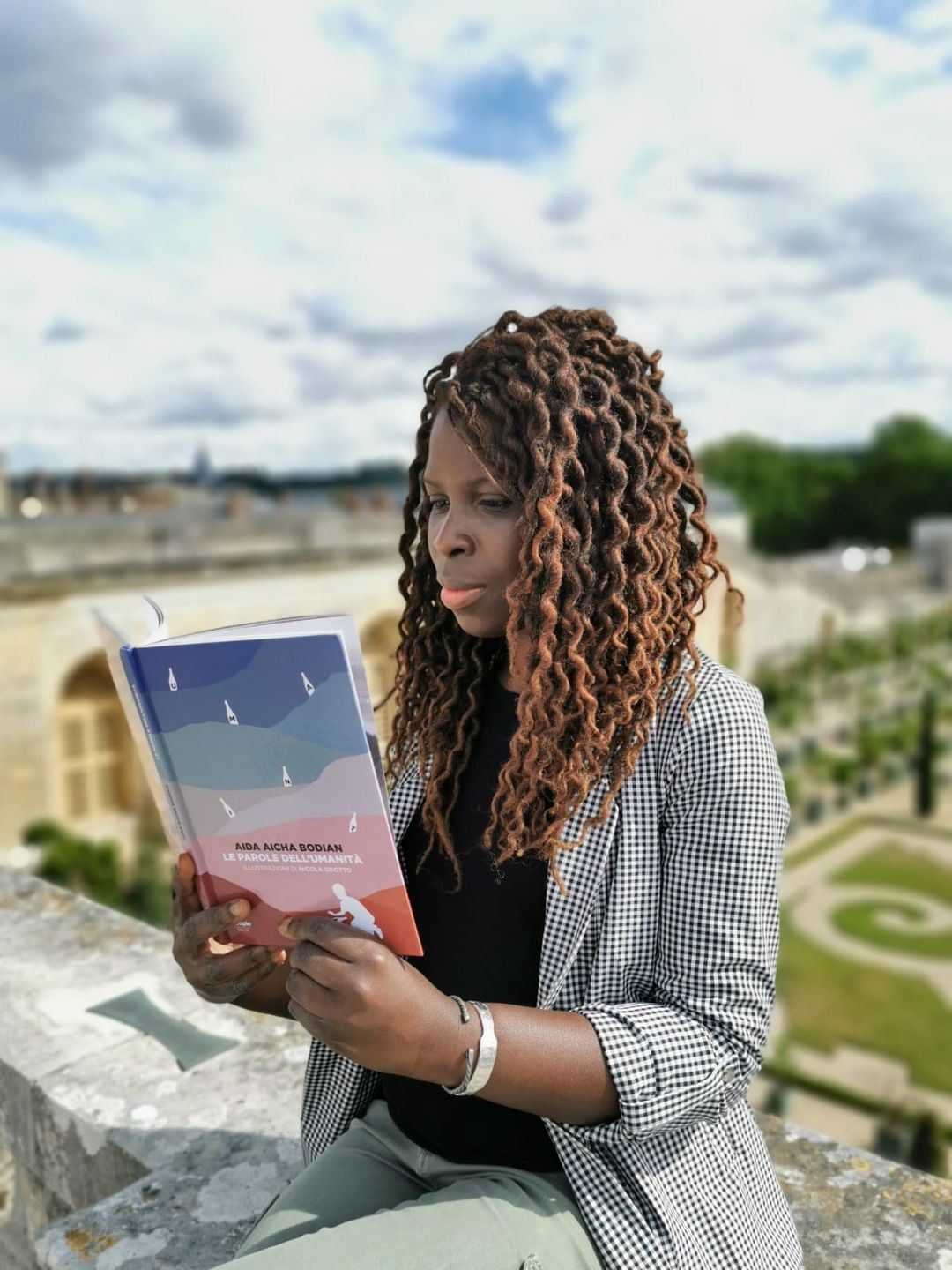
Interview with the artist Nicola Grotto
I have always thought that sometimes you need a good dose of luck and chance to meet the right person at the right moment, to get the desired job, or to achieve a goal.
A few years after the release of Le parole dell’umanità, reflecting on the path that brought us here, I am convinced that luck has little to do with it, and nothing happens by chance.
It is no coincidence that everything began in a place that values the intersection of cultures and seemingly distant worlds. A place that fosters encounters, the crossing of people, their stories, and their ideas (and what could be more enriching than exchanging ideas?).
This place is the festival Ritmi e danze dal mondo in Giavera del Montello, and it is here that I first met Aida. I don’t remember the exact moment, but I remember well the fraternal spirit, the atmosphere of freedom and mutual exchange, which has accompanied us in all subsequent collaborations to this day.
Aida was, and still is, a volcano of ideas, projects, and tenacity in carrying them out. I, less pragmatically, sought to communicate, raise awareness, and convey emotions in the only way I knew: painting. Two different personalities, but perfectly compatible, with common ideas. Coincidence?
I am self-taught but have painted and drawn all my life, always fascinated by people, by the beauty of the little details that make us unique. Since I was a child, I have loved observing people, imagining the stories of strangers I met, simply by noticing an expression, a smile, a sad or happy glance.
It is no coincidence that I chose portraiture as my artistic form. I believe much can be conveyed through a look, an expression, a detail. I particularly love portraying ordinary people, especially children, because everything is instinctive, there is no pretense in their emotions.
Astonishment, curiosity, wonder, these are peculiar characteristics of children, but essential in all of our lives and especially for an artist. Capturing all this in my paintings is my goal.
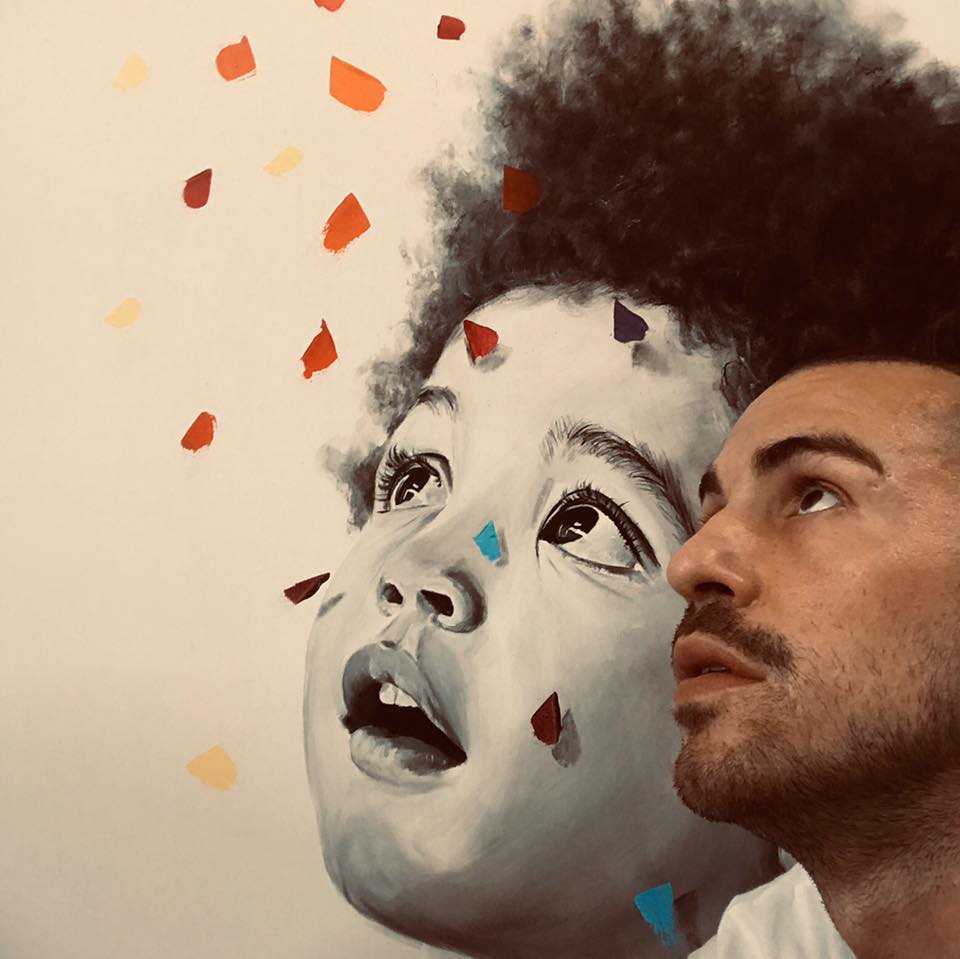
When Aida proposed I illustrate Le parole dell’umanità, I found the book’s content perfectly aligned with my thoughts and way of painting.
The apparent simplicity of words contrasted with the depth of their meaning, often underestimated or taken for granted, seemed a perfect metaphor for our society, where people are often judged too quickly without truly knowing them or their story. The magic of words, pronounced differently yet carrying the same meaning, evokes the same reaction in both speaker and listener, from Rome to Beijing, Bogotá to Dakar, Oslo to Baghdad. Words that remind us that, in the end, we are not so different.
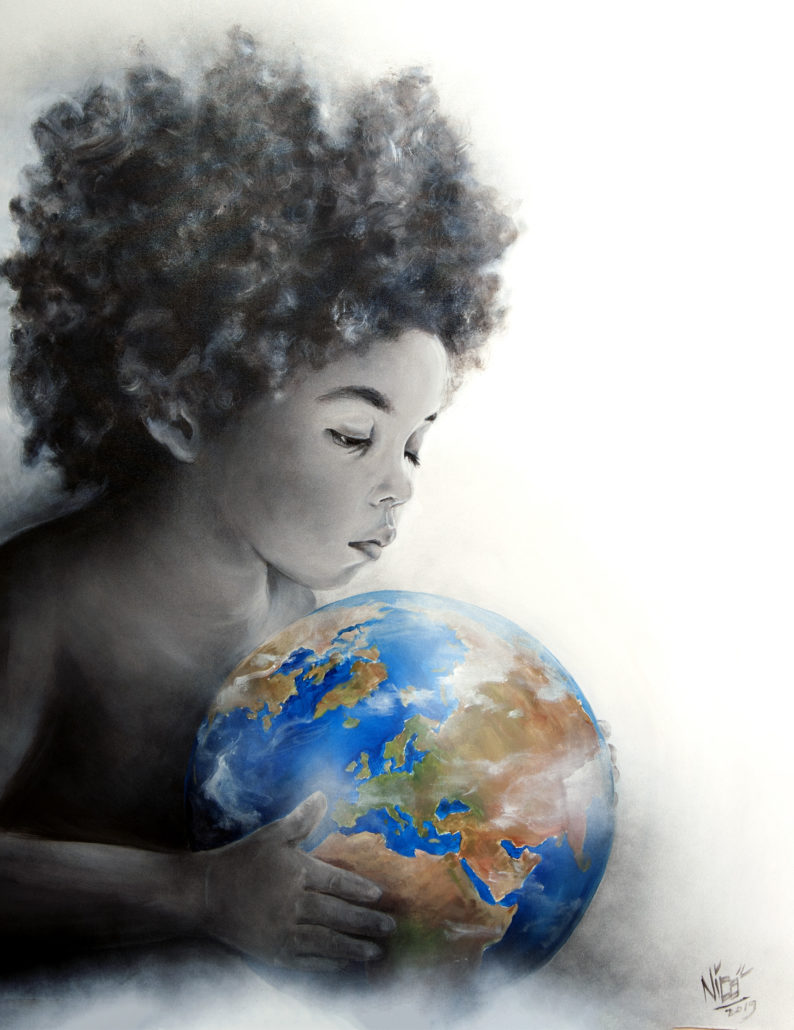
As I am not a professional illustrator, I could interpret the words artistically while maintaining my painting style, creating 23 canvases, one for each word, whose photographs appear in the book. It was not an easy task, reflecting on and interpreting words like “empathy,” “live fully,” or “beauty” is no small feat, but Aida’s complete trust gave me full freedom.
I have always been fascinated by creating images that are simple, direct, and immediate to the viewer, yet capable of deeper personal interpretation. Going beyond appearances.
The glossary definitions of each word, translations into 23 languages, and Aida’s sensitive reflections created the perfect blend of images and words.
In short, a project that seems countertrend in our times, and precisely for that reason, captivating. Countertrend because we live in a scientifically and technologically advanced era, where we have gone from mastering technology to being dominated and conditioned by it, gradually neglecting our most important component: humanity.
We still carry the scars of a pandemic, which deeply affected us, swept away our certainties, and instead of uniting us against a common enemy, isolated us, highlighting our differences, fears, fragility, and lack of humanity.
In short: a place that values diversity, encourages encounters and exchange of ideas and skills, gives birth to a book of images and words, released at one of the most challenging historical moments humanity has faced, as if a manual to remind and teach us, if we had forgotten — that sometimes all it takes is a moment’s pause to appreciate the beauty of small things, small actions, simple words: our humanity.
Coincidence?
Do we still need of “Words of humanity?
This book, published by People in 2020 and intended for all ages, is a memorandum of humanity’s words, those small expressions taught to us as children whose value we may have forgotten as we grew. Small actions to rediscover, gestures that benefit ourselves and others.
Why these twenty-three words? Simple: I don’t believe healthy relationships among humans, or with the Earth itself, can be built without them.
Take, for example, “ciao” and “welcome.” Ciao was the first Italian word I learned in 1992, when I first landed in Italy. Giving a welcome is a good practice, a principle I inherited from my native Senegal, the country of Teranga, the art of hospitality. Greeting is the first step to establishing relationships, to creating bonds and connections with the world and those in front of us, yet we often fail to do it. If we slow down and try to be less prejudiced, there is always time to greet and, why not, welcome a stranger, extend a hand, offer a warm meal and safe shelter.
How many words convey sweetness and well-being both to the receiver and the speaker? Thank you is one of them. Saying thank you centers the other person. Gratitude is an art encompassing beauty, pleasure, humility, kindness, and authenticity. Helping and being helped nurtures relationships. We should also give ourselves a daily dose of the therapy of a smile, a universal language that invites connection, teaches respect, and helps recognize the value and dignity of others.
Let us learn to pay attention to others, to notice that we are not alone. How? By listening, hearing is no longer enough. There are countless trainings on public speaking and impressing audiences, but how many teach us to listen? Do we have the courage to do so?
Speaking of courage, do we still possess it, or have we left it to the heroes of the past? Courage is a word we should always keep with us, like bread in the house. Its origin is the Provençal corage, from Latin cor, meaning “heart.” Courage is not recklessness, swagger, or violence, but something pure, starting within us and becoming exemplary for others. It is not about raising your voice or hands, but choosing to do the right thing, acting with heart. Do we still have the courage to speak, act, give, forgive, trust, take responsibility for others, for our wonderful Earth, to be unique, daring, dreaming, and truly living? Life is the most extraordinary thing, and we barely notice it. Can we still recognize beauty? Can we still marvel at the small and great wonders life offers us daily? Let’s try.
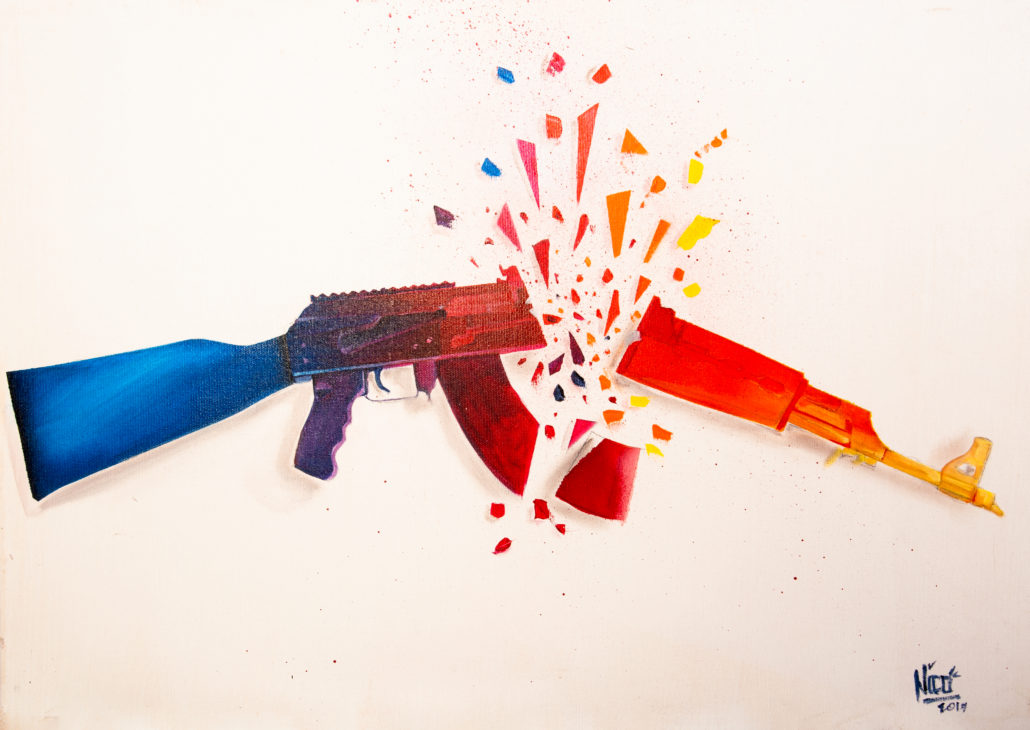
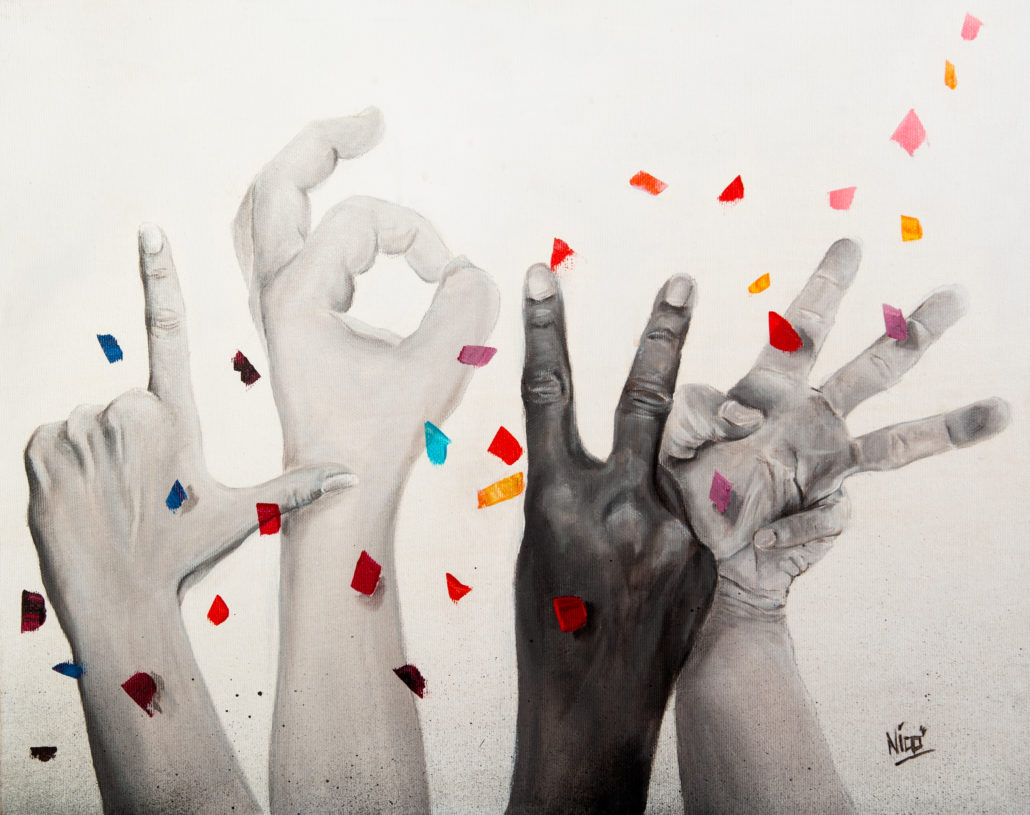
Talking about peace in these times is extremely difficult, but essential. Peace is humanity’s greatest good, more precious than millions of gold bars, perhaps more valuable than immortality. Peace is not possessed but built, moment by moment. It is like a warm, embracing flame to keep alive, because without it we fall into darkness and coldness. Every day, we should be ambassadors of peace, shouting these two powerful, sweet syllables in all languages, as loudly and far as possible. Let us spread peace and love, pure love. This overwhelming, powerful force can be intimidating, perhaps because it is the one energy humans have not learned to manipulate at will. And perhaps this is a good thing. We are like fireflies, bearers of light for ourselves and others. Let us illuminate this world with good actions and spread love in all its forms.
I like to think that this small educational and artistic project can awaken hearts, dust off feelings and values. Ambitious? Perhaps. I think dreaming never hurts, and when many dream together, it can become reality. Little is needed to create beauty: a simple book, a multicultural dinner, an art exhibition, shared moments of silence and dialogue.
Perhaps in these times of mistrust, violence, crises, disasters, and disease, we still need to rediscover certain values, certain expressions that help us feel more. Let’s return to humanity with what is most human in us: words.